Friday, December 25, 2009

Tuesday, July 21, 2009
Rajaji


The last days of the year 1931, in the Central Jail at Vellore. A number of freedom fighters were imprisoned there. Some of them were sitting under a tree in the open yard. As they were chatting, a lean man, wearing dark glasses, and trying to tighten the dhoti he was wearing, walked across the courtyard. The men who were squatting under the tree stood up respectfully.
"Who is that?" one of them asked.
"You don’t know? He is Rajaji, the man who is worthy of being our Governor General" replied Professor N.G. Ranga, who happened to be there.
About seventeen years later, Rajaji did become India's Governor General.
The Governor General
The fifteenth of August 1947.The shackles of India's political slavery were at lasting broken. The country became independent. The determined fight under leaders like Mahatma Gandhi, Sardar Patel and Nehru forced the British to quit India. For a few months, Lord Mountbatten was the last British Governor General. He was to return to England in June 1948.
An Indian had to take over as the Governor General.
'The Post of the Governor General of free India is really a very high one. Who can worthily fill it? This was the question every where. All eyes turned to Rajaji. Rajaji became free India's first Indian Governor General.
He held the reins of administration for some twenty months and proclaimed India
a Republic on January 26, 1950.
Rajaji was a great patriot, an unequalled statesman, a great social reformer, an
able administrator, a popular writer, freedom fighter, an intimate associate of
Mahatma Gandhi, one of the makers of modern India, a great leader of the Gandhian era and the founder of the Swatantra Party.
The Chakravarti Family
Rajaji's real name was Chakravarti Rajagopalachari. People affectionately called him Rajaji.
How the family got the name of Chakravarti is an interesting story. In Sanskrit, 'Chakravarti' means the King of Kings. Once when an ancestor of Rajaji was bathing in the river near their village, he saw a dead body come floating down the river. Fearing that if left so to float, vultures would only eat up the body, he pulled it out of the river and cremated it. But later, it became known that the dead body was that of a Harijan, considered by Hindus as an outcast. Hence the Brahmins of the village expelled him. One day he had to perform an annual ceremony in memory of a dead ancestor. Such days are very sacred to Brahmins. But no Brahmins would agree to go to his house and partake of the ritualistic meal. Rajaji's ancestor was in great grief and anguish. Just then a person came along and said he was a Brahmin; he said he would perform the worship in that house and partake of the meal. As he was about to leave, he blessed the householder saying "Nallan Chakravarti" meaning a good Emperor. Then he vanished. The people who were they’re thought he was no ordinary mortal, but a super human being. From then on this family got the name of Chakravarti family. So goes the story.
Prosperous Lawyer
Rajaji was born on December 8, 1878 in Thorapalli Village near Hosur in Salem District of Tamilnadu. His mother was Shringaramma. His father Chakravarti lyengar was not only the village munsiff but also a great scholar in the Vedas, Puranas, and other Sanskrit lore. Rajaji completed his primary education in his native village and then joined the District Board High School at Hosur. Later he passed the B.A. degree examination from the Central College in Bangalore and secured a Law Degree in Madras.
When he was studying in the Law College in Madras, an interesting incident happened.
Swami Vivekananda visited Madras. He was put in the very hostel where Rajagopalachari was staying. Going round the rooms of the students in the hostel, he entered Raja- gopalachari's room. He saw on the wall a picture of Lord Krishna. He asked, "Why is Lord Sri Krishna blue in hue?" Raja- gopalachari, still a student, answered: "Sir, the sea is limitless. So is the sky. And both are blue. God is also boundless. And so His hue is also blue."
Swami Vivekananda was overjoyed. He said the young boy would rise to eminence and would become very famous.
It was in Salem that Rajaji began independent practice as a lawyer. He was just twenty years old. He came to be known as an expert in conducting criminal cases. He was so skilful that he won even very complicated cases quite easily.
Soon Rajaii became very famous as an advocate in Salem. He was the very first person there to own a car. When he was twenty, he married Alamelu Mangammal.
When he was just twenty-one, he conducted very difficult cases independently. His knowledge of law, his intelligence and his fearlessness brought him great fame and wealth in a short time.
Just then, the Government had prosecuted a patriot by name Varadarajulu Naidu; the charge was that he had spoken against the Government. Rajagopalachari was the advocate for Varadarajulu Naidu. Whenever Rajaji stood up to speak, the judge would say "Please sit down." Next day, at the very outset Rajaji stood up and made a submission: "I have great respect for the Honorable Judge. But if like a teacher in a classroom, Your Honor always asks me to sit down, I shall not be able to discharge my duty; and it will not add to the dignity of this court." The Judgeapologized to Rajaji. Finally, on the basis of Rajaji's arguments, Varadarajulu Naidu was acquitted.
The Municipal President
Rajaji believed that the individual was part of society and must make his contribution to social life. In 1917 he becamePresident of the Municipal Council in Salem. No sooner, did he become President than the work of the local body got a new impetus. He started adult education classes and also night schools for factory workers. Schools for Harijans were also opened. Rajaji appointed a committee to prepare a glossary (list of difficult words) in Tamil so those science subjects could be taught in that language. He also drew up a plan for the supply of water to Harijans. A Master plan for the development of Salem was also formulated.
Rajaji did much to better the lot of the Harijans. When he admitted Harijan students into a hostel, even some elders whom he respected very much opposed him. But Rajaji did not relent or retreat.
With National Leaders
Even from his student days, Rajaji was interested in politics. During those days he had the good fortune of being guided by great men like Chidambaram Pillai and Subrahmanya Bharati. He came under the influence of leaders who were trying to awaken the Indian people from slavery. Annie Besant, Bala Gangadhara Tilak and
others began to appreciate Rajaji. That Rajaji entered the political arena was not surprising. In 1916, the Government of India arrested Annie Besant. When the train carrying her came to Salem, people gathered in a large numbers to see her. But the authorities would not permit it. Then the people squatted on the rail track.
The Collector of Salem called in the police and was about to order them to open fire. Rajaji talked to him, argued, and guaran- teed that the people would be orderly and nonviolent. Then the gathering offered garlands to Annie Besant and showed its gratitude. Rajaji later argued on behalf of Annie Besant in the law court, and she was released.
In South Africa, the Government and the Whites were treating non-White population like dirt under their feet. Gandhiji put up a tremendous struggle against that. It was on account of the Satyagraha conducted there that Gandhi’s extraordinary quality of leadership came to the limelight. When Gandhiji returned to India, Rajaji also accepted his leadership.
Rajaji suggested to the then Editor of The Hindu, Kasturi Ranga Iyengar, that Gandhiji be invited to Madras. An invitation was accordingly sent to Gandhiji. When Gandhiji came, he stayed in Rajaji's house. For sometime Gandhiji could not make out that it was Rajaji who had invited him and that he was in Rajaji's house. The way
Rajaji conducted himself, Gandhiji thought that he too was a guest!
Against Untouchability
Rajaji held that the removal of Untouch- ability was very important. He admitted Harijans to the "Gandhi Ashram" which he founded. His cook was a washerman.
Once it happened that a Harijan devotee entered a temple. He had religious ash- marks on his forehead and arms and was singing hymns. Some fanatics prosecuted him in a court of law. Reading about it in the newspapers, Rajaji was pained. He took up his case in the court and argued on his behalf.
In those days Harijans were not allowed to enter temples. Rajaji tried very hard to see that" a bill removing this disability was passed in the Madras and Central Legis- latures. But he did not Succeed. Rajaji was the first to work for legislation for the removal of Untouchability. He had to face intense opposition and many obstacles. But he was undaunted.
Rajaji never cared for caste restrictions. He gave his daughter Lakshmi in marriage to Gandhi’s son Devadas.
In the Whirligig of Politics
Rajaji's political life had a strange course. He was the General Secretary of the Indian National Congress in 1921-22. For two decades from 1922, he continued as a working committee member. He became a frontline leader of the Congress, and was a confidant of Gandhiji. His extraordinary genius was well known to all. He participated in various Satyagraha movements and was imprisoned fivetimes. When Gandhiji began the salt Satyagraha, Rajaji led a procession from Tiruchirapalli to Vedaranya and began making salt on the seashore. They were all arrested by Government and sent to prison.
When, for the first time, the Congress participated in the elections, Rajaji became the Chief Minister of the then Madras Province. But he resigned from the Congress in 1942. The Muslim League under Jinnah put forth the demand for Pakistan. It insisted that grouping together Muslim majority provinces and dividing India into two should create a separate nation. In the early stages the Congress opposed the demand. But Rajaji said that it was better to accept the demand for Pakistan. Many Congressmen criticized Rajaji very harshly. Rajaji left theCongress. But the same Congress agreed to the demand for Pakistan in 1946!
Rajaji again joined the Congress in 1945. He became a Minister when Jawaharlal Nehru formed a Government on the eve of independence. The state of West Bengal had certain serious problems.
Rajaji became the Governor of that State in 1947. When Lord Mountbatten returned to England, Rajaji became the Governor General occupying the highest position in free India. Later, he was Home Minister in the Central Government. By then he was 72 years old, and he needed rest. He gave up the Ministership and returned to Madras and the world of letters. He began a study of the Ramayana.
A little later, when the Congress Party in Madras again urged him to take up the leadership, he said, "No. I am old, and I do not want any power or responsibility." But finally he had to agree and in 1952, at the age of 75 years, he became the Chief Minister. He infused a new dynamism into the Congress before retiring. But he became disgusted with the way the country's affairs were going on. He felt that in the havoc created by the control-licence -raj, corruption became rampant and the nation's life was in a shambles. It became clear that if there were no strongopposition party in a democracy, it would only be a travesty of democracy. So, the 82-year-old hero founded a new party called "The Swatantra Party". It was the main opposition party in the Lok Sabha till 1969.
Prison and Politics
Rajaji hated sloth- even when he was kept in prison, he converted it into a school. He gave of his knowledge to his co-prisoners. He would recount the stories of the Ramayana and the Mahabharata to them. Not only did he seriously study many a book in prison, but he wrote some books too. It was in prison that he wrote his book on the ancient Greek philosopher, Socrates. It became a famous work.
Many a time when there were quarrels between the prisoners and the officials of the goal and the situation became tense, Rajaji would step in as peacemaker. So even the prison officials had greataffection and regard towards Rajaji.
A feeling has grown that politics means competition and hatred. But the way Rajaji conducted himself in politics was remark- able.The well-known leader Satyamurty and Rajaji belonged to opposite groups in politics. Still whenRajaji was giving up the Presidentship of the provincial congress committee, he tried hard to see that Satyamurty was greatly surprised by knowing this thing. He freely praised Rajaji and said, "I never knew that Rajaji had a heart of gold!"
Satyamurty was the only leader who had not courted arrest even sometime after Gandhiji began the Non Co-operation Movement in 1930. All other leaders of Madras were in goal. Rajaji went straight to Satyamurty, though he was his political opponent. He told him, "All other leaders of Madras have gone to goal. It is a question of the prestige of Madras. So you must also participate in the Satyagraha now." Satyamurty agreed. Both of them picketed before a shop selling foreign cloth and courted arrest. That was the first stretch of prison life to Satyamurty.
Simple Life
Rajaji lived in an utterly simple way throughout his life. He had inherited property. Within a couple of years after enrolment as a lawyer, he was earning two to three thousand rupees a month. But he lived a very simple life. He never left the path of virtue. His life was dedicated to righteousness. He was like Bhishma in
righteousness, and in statecraft like Chanakya.
Rajaji always wore Khadi. He firmly believed in the need to use Khadi and Swadeshi articles. Even when he was in prison, he used to spin for a few hours every day. As for his clothes, he wore a dhoti, a jubba (a loose, long shirt) and a shawl on his shoulders. That was all. And he wore dark glasses. He had to wear them always because of some eye ailment. Someone once asked him about it. Rajaji humorously said, "When I meet anybody, I must look at him well and know about him. But he should not see in my eyes what I think of him. So I wear these dark glasses."
The Fearless Hero
There were three prominent traits in Rajaji. The first was fearlessness. Never would he refrain from saying or doing what he thought was correct because it might displease someone or it might be unpopular or those in power mightbecome angry. When he was yet very young, he was an admirer of a Swamiji by name Sahajananda, who was a Harijan. When the Swamiji came to Salem, Rajaji and his friends arranged a dinner for him. Some orthodox persons became wild with anger at this, and they ex-communicated Rajaji and his friends. The priests would not go to their Houses to officiate at religious functions. But Rajaji remained undaunted by any of these things. When he went to Bombay in 1941, he had to face a black- flag demonstration against him. Some threw stones at him in the public meeting. But Rajaji did make his speech. In just a few minutes, there was calm and the people listened to him.
Rajaji had unflinching faith in Mahatma Gandhi’s philosophy and principles. He always followed them. He was also very close to Gandhiji. When an association was started in Madras to explain to the people, the philosophy behind Gandhi’s method of Satyagraha, Rajaji was chosen president of that body. Gandhiji was very happy when he heard of it. Of curse, Rajaji was not a man to accept the ideas and views of others without examining them. Gandhiji so even with the ideals preached it.
When the question of dividing the country arose, every Congress leader opposed it. Still Rajaji supported the demand for Pakistan. He kept aloof from the 'Quit India' movement started in 1942 to get the country's independence from the British. He was the only leader who did not take an active role in that movement. So he resigned from the Congress in 1942. Some accuse him of being the cause for the rise of Pakistan. He had to face the hostility of the people who thought that he supported the creation of Pakistan. It became difficult for him to speak in meetings. Quite a few leaders also criticized him harshly. But Rajaji faced not only harsh words but also stones, and justified opinion.
At the time Rajaji started the Swatantra Party, the Congress Party and Jawaharlal Nehru had tremendous influence in the country. But Rajaji did build this opposition party. And till his last day, whenever he felt that either the ruling party or very popular leader like Nehru was making a mistake, he roundly condemned it.
During the Second World War (1939-45), when it seemed the Japanese would bomb Madras in 1942, the Governor of Madras fled the city. The people also started appealed to them. This is our country, not of the British. They may run away. But in those days of run a teashop in the Hindi Prachar Sabha Bhavan.
An Extraordinary Genius
Secondly, Rajaji was an extraordinary genius. He was known for his sharp intellect. He could grasp any subject easily. He could pinpoint in a split-second the essence of any situation or problem. Because of such clear thinking and sharp understanding, his speech was also balanced, clear and to the point.
As an administrator he displayed dareness and a keen intelligence.
He was the Chief Minister of Madras in 1937. Then he introduced prohibition. This was being done for the very first time in India. But prohibition meant loss ofrevenue to Government. So he introduced Sales Tax for the first time. Many economists also welcomed the measure.
The farmers in our country were bowed and crippled by the weight of debts. Every farmer’s family was in debt, and the every interest on it was enough to ruin the family. A farmer was born as a debtor, and he lived as a debtor and finally died in the same conditions. To remove this pernicious evil, Rajaji brought in a new regulation. He banned the charging of unreasonably high interest.
As Chief Minister of Madras, Rajaji had laid for himself a very high code of conduct, others would have found it impossible to follow it. He exercised great caution to see that he and his Ministers remained untouched by corruption. He always went to the State Legislative Assembly ready to answer any question or supplementary.
He had asked other ministers also to be similarly prepared.
In 1952, Rajaji again became the Chief Minister of Madras. He removed allcontrols on foodgrains. Several Ministers at the Center and also others thought that Rajaji had taken a wrong and hasty step. But soon it was evident that what he did was right. So all over the country, the controls on foodgrains were removed. Two years later he felt that the educational system in the State should be radically changed. There was great opposition to this. So he resigned.
Service-minded
The third important trait in Rajaji was his service-mindedness. He had become quite rich while quite young. If he had continued as a lawyer and had not entered politics, he could have been very wealthy. He could have led a life of luxury. He gave up such a career for the sake of the country. He went to goal five times. Another Congress leader, Kaleswara Rao, has narrated how he became the Chief Minister of Madras. Rajaji never wanted any position. Vallabha Bhai Patel himself suggested that Rajaji should be the leader of the Party. "I do not want all that," said Rajaji. He just would not listen. Kaleswara Rao became angry. He said, "It is now your duty to lead the Party. If you do not wish to do your duty, why are you here? You can go anywhere.Go to theHimalayas. But this is not the place for you. Yes, please go away." Rao was shouting in fury. Finally, with great effort, Patel had to persuade Rajaji. As Governor General, he had held the highest position in the country. Any one else in his position would have said, "I was the Governor General of India. How can I accept a lower position?" But Rajaji had no such thought. Hebecame a Central Minister and later the Chief Minister of a state. When he felt that his work was over, he promptly laid down office. When he started the Swatantra
Party he was a very old man. He wanted no position for himself. Building up a new party meant hard work, he could expect no personal gain. But he felt that in a democracy there should be a strong opposition party. If there is no such party, the Government will Becomeirresponsible. So he started and nursed and built up the new party.
It was only once that Rajaji went outside India. Representing the Gandhi Peace Foundation, he visited Britain and the United States of America in 1961.
At that time, he was 83 years old. The old sage went out only to utter a few words of wisdom. Powerful nations of the world were competing among themselves; they wanted to make atom bombs and even more destructive weapons. Rajaji was troubled. He thought that if it went on, all mankind’s would be destroyed. So he wished to warn that even the mostpowerful nation must consider the welfare of humanity at large. He went as the leader of a mission, which wanted to appeal, that suicidal atomic experiments should stop. He talked to the then President of the United States, John F.Kennedy, for forty-five minutes. Kennedy later said that the discussion brought him the great influence of a pure and gentle culture.
Popular Writer
Rajaji was a very popular writer in Tamil and English, Some of his books have a unique place in the world of letters. He has also translated some Kannada stories into Tamil. He has written more than thirty books. His books on the ancient Roman King Marcus Aurelius, on the Bhagavad- Gita, the Ramayana, the Mahabharata and the Upanishads are all very famous. Even a common man can read and understand his writings. Rajaji said, "My books on the Ramayana and the Mahabharata are my greatest service to my people." There is no exaggeration in it. Their simple style is very attractive.
They are books, which every Indian should read and enjoy. By translating the Ramayana and the Mahabharata into simple and beautiful English, Rajaji has made it possible for the people of the Western countries to read and enjoy these great epics of India. The Mahabharata written in English by Rajaji is a textbook for Oriental Studies in five American Universities and more than three lakh copies of it have already been sold. Two lake copies of the Ramayana have been sold. Rajaji spoke and wrote very simple language. He was a great scholar, but his language was never pedantic. When people heard him speak, they were amazed that difficult and profound ideas could be expressed in such simple words. The same feeling comes when we read his books. Rajaji's stories have their own charm. He had a fine sense of humor. Even while speaking in the legislature, according to the situations he was telling some stories. He wrote many articles in the "Swarajya". He dealt with every subject in the country's affairs. Any article by him on any subject always presented a new
angle. It would make the readers think again. But the language was quite simple.
It was Rajaji who introduced teaching of Hindi compulsory in Madras. But twenty years later Rajaji himself led the agitation against Hindi. He felt strongly that in the eagerness to spread Hindi as the national language, the regional languages should not be adversely affected; their development should not be harmed.
Words of Wisdom
Like many a great person, Rajaji also could foresee the future. Even when he was in prison in 1921, he wrote in his diary; "Freedom will come; but immediately thereafter or even for a long time it may not bring the people happiness or a good government. As soon as freedom comes, there will be a scramble for electedplaces; in its wake will come corruption, injustice and the wickedness caused by money and an inefficient administration. The life of the people will be like hell. Many will feel that the older regime, which was comparatively more just, efficient and honest, was better. What we get from our independence will be only freedom from indignity andslavery. Our future lies in making our youngsters good citizens by giving them from early days an education, which is likely to create good conduct, righteousness and mutual love. If that is not done, it is certain that they will be crushed under the wickedness of injustice and wealth."
Many of Rajaji's ideas deserve serious consideration.
Rajaji had something interesting to say about celebrating birthdays. He felt that in our country we went too far in the matter of celebrating the birthdays of grown-up persons. Suppose we admire a leader we celebrate every birthday of his-the fifty- second, the fifty-third, the fifty-fourth and so on. Is this quite necessary? Suppose we celebrate his 50th birthday, his 60th birthday, his 70th birthday and so on. We shall be honoring him once in ten years. Is this not enough? It is different withchildren. There is nothing wrong in observing it every year for a little one. But there is certainly no propriety in observing the birth anniversaries of our grown-up leaders every year as we may do for children. We do go too far in declaring holidays. We seem to think that the best way to show respect for a great person or a great event is to give up work on that day. The folly is self-evident.
Rajaji never sought fame. He did not attach any importance to it. He knew that he was not exceptionally popular; he knew that quite often those who agreed with his views were very few. Once somebody mentioned this to him. Rajaji replied,"Our ancient sages did not give up their firm belief in their ideals just because they did not have many followers".
Some persons once went to Rajaji to discuss with him about the celebration of Gandhi’s birth centenary. Rajaji said, "But we do not see Gandhiji in the political, social or economic spheres in the country. In this state of affairs you are thinking of celebrating the Gandhi birth centenary. You are brave men!" There was a touch of humor, but the pain in his mind was obvious.
Not after Popularity or Happiness
Rajaji's interest in the affairs of the country and his concern for the future always remained the same. They did not diminish a whit till the very end of his long life. He was troubled deeply that people of the country were not happy, that moral standards were going down in public life and that persons in public life did not have
even basic honesty.
This unequalled intellectual passed away on December 25, 1972. He was then 94.
Rajaji received in his life both great honor and violent criticism. He heard theharshest words of criticism from his owncolleagues. People who could not understand him pelted stones at him. He withstood all that. And he was the Governor General of India. He was also the recipient of the highest award, the Bharata Ratna. Rajaji, who explained the meaning of the Bhagavad- Gita in his books, had imbibed its essence in his own life. Praise did not elate him; malicious words did not upset him. So many people reproached him saying that he encouraged the creation of Pakistan. Rajaji also did want an undivided India. But he came to the conclusion that India could not get freedom unless Pakistan was conceded to the Muslims. If some people want Pakistan, why keep them with us by force? Let us give them what they want let them experience the happiness or the misery or their new state. This is political wisdom. So ran his thoughts. Gandhiji himself once said, "If I had made over the leadership to Rajaji, I would not have had to see the bloodshed that occurred for the division of the country. He can see six months ahead of me."
Rajaji did not get much happiness in his family life. When he was just thirty-five his wife died. He was very young and also had a very good income. Many relatives and friends told him that he should marry again.
Rajaji, who had five children, said in his own humorous way, "If I marry again, I would have to look after the sixth child along with the five I have."
Constructive Work
Rajaji was proud of India. He had studied deeply the history of India, its literature and culture. His pride was rooted in this knowledge. He always thought of the welfare of the country. He worked for it in several ways. He practiced the teachings of Gandhiji. Gandhiji had told his followers that it was not enough to fight against the British, their sacred task included hard work for developing our motherland, Rajaji always wore Khadi, and never failed to spin even in prison. He set up and ran a Gandhi Ashram in a village called Pudupalayam. He supplied. Spinning wheels and cottons not only to those in the Ashram but also to people in the villages around. He made arrangements for the sale of the yarn spun by the villagers. There was a school in the Ashram. Quite often Rajaji was found teaching in the classes. His son, who was a doctor, attended on the people in the Ashram and the villages nearby. Rajaji periodically visited the villages. He arranged Jor the
digging of wells. He advised people to give up liquor. He started bee keeping in the Ashram and taught people to earn money in this way. He was convinced that the two great evils of Indian society were drinking and Untouchability, so he fought against them tirelessly when he was in power and later too. He was also responsible for starting over two hundred co-operatives.
A Child of India's Culture and a World Citizen
Rajaji was a child of Indian culture. At the same time he saw all mankind as one family. It seemed to him that selfishness and foolish notions of prestige blinded the powerful nations of the world. They were madly making most modernized weapons of mass destruction. They would plunge themselves and the whole of humanity in misery. Even in extreme old age, Rajaji tried to prevent this.
Rajaji was grieved that freedom did not bring happiness and joy to the people of India; he was unhappy that the greed for money and power was ruining national life. He was the center of a hundred controversies. Different people may find this or that view of Rajaji unacceptable. But there can be no difference of opinion that Rajaji was the most brilliant leader of India in the twentieth century, and one who spoke fearlessly for the weal of India and the World.
Lala Lajpat Rai

It was the evening of October 30, 1928. Standing on the platform at a crowded public meeting in Lahore City, a person known as the 'Lion of Punjab, 'said in an inspiring voice:
"Every blow on our bodies this afternoon is like a nail driven into the coffin of British imperialism."
Terrible blows had battered the chest and the body of the great man who made that stirring speech. The humiliation inflicted by the high-handedness of the British was more painful than the wounds.
On the morning of the seventeenth day after this, the great revolutionary died. Onward along the path he had trodden his followers marched towards freedom.
The great leader cut down by the high- handedness of the then imperialist Punjab Government was Lala Lajpat Rai.
An Intelligent Student
The great patriot Lala Lajpat Rai was born on 28th January 1865 in Dhudika village of Ferozepur District of Punjab Province, His father Lala Radha Kishan was an Urdu teacher in a government school. He belonged to the family of Agarwals, a family noted for its love of freedom and self-respect. Although illiterate, Lajpat Rai's mother Gulab Devi was an ideal Hindu woman. It was from her that Lalaji imbibed patriotic sentiments. Lalaji was a very intelligent pupil. He won scholarships. Poverty and sickness stood in the way of his higher education. He passed the Entrance Examination of the Calcutta University in the first class in 1880. The same year he also passed the Entrance Examination of Punjab University. Afterwards he joined the Lahore Government College. At the same time he studied law. Because of the poverty of the family his education was interrupted for two years.
The Dawn of Ideals
The two years spent in Lahore were important in Lalaji's life. As he read the history of the past glory of India and the biographies of her great sons, the boy shed tears. The love of freedom and the keen desire to serve the country took root in him at that time. During those days the Arya Samaj founded by Swami Dayananda Saraswati was dynamic in social service. It was a time when enthusiastic Punjabi youths were attracted by the progressive ideals and reformist plans of the Arya Samaj. Lalaji was then hardly sixteen. When he joined the Arya Samaj in 1882 his life of social service began. Patriotism was kindled. The idea took root in his mind that the chains of Indian slavery should be broken.
The Lawyer
Having passed the first examination in law in 1883 Lala could practice as a muktiar (a minor lawyer). He had also to bear the burden of running the family. Eighteen- year-old Lalaji practiced in the revenue court of Jagrav town. After passing the Pleaders' Examination he came to Hissar in South Punjab and commenced practice as a lawyer.
He had no thought of making money in his profession and settling down comfortably. He wanted to devote his life to the service of his country. He wanted to read the biography of Mazzini, the brave revolu- tionary of Italy. He could not get a copy of the book in India. Lie wrote to a friend in England and got it. Mazzini's bravery, magnanimity and patriotism thrilled him.
The Beginning of Public Service
His life of six years in Hissar became the apprenticeship for public service. After the death of Swami Dayananda, Lalaji with his associates toiled to develop the Anglo- Vedic College. The three tenets of Arya Samaj are the reformation of society, the advancement of Hindu Dharma and educational progress. Lalaji earned a thousand rupees a month. He kept aside a part of his earnings to keep his father above want and arranged for the interest on it to be paid to his father. on tenth of his income was earmarked for work for the nation. The greater part of that sum was being used for Arya Samaj activities.
When the Lieutenant Governor visited Hissar, Lalaji pleaded that the Welcome Address to be presented to him should be in Urdu. To satisfy the British officer a speech had already been prepared in English. Lalaji's suggestion madeeveryone nervous. But without a trace of fear, he presented the Address in Urdu and there by invited the wrath of the British.
Most of his time was given to Arya Samaj activities. Working ceaselessly he set up branches of the Arya Samaj. He built up educational institutions. But he was not partial towards any community. He was elected unopposed to the Municipal Council from a constituency where there were a number of Muslims.
To The Political Sphere
In 1888, still a lawyer, he entered politics. The Indian National Congress was fighting for the country's freedom. Realizing the dire need for freedom, Lalaji joined the Congress as a freedom fighter. Sir Syed Ahmed who was in the Congress had just then left it. He had begun to argue that Muslims should not join the Congress and that they should support the government. Lala wrote bitter open letters to him in the Urdu weekly Koh-i-noor'. The letters earned high praise in political circles. The same year in the Congress session at Allahabad, when Lalaji arrived with eighty delegates from Punjab, he received a tumultuous welcome. his heroic speech in Urdu there had a great effect on the Congress leaders. Lala was a young man of 23 years. His fame spread quickly in Congress.
In Lahore
The small town of Hissar proved inadequate for his growing social work. After qualifying to practice as an advocate in the Punjab High Court, he settled down in Lahore in 1892. The Congress session of 1893 was held at Lahore. The first Indian to become a member of the British Parliament, Dadabhai Naoroji, was the president of the session. Lalaji served as an enthusiastic volunteer.
Lalaji worked like a bee. There was no time for rest. When he was immersed in Congress work there was a split in the Arya Samaj. Lalaji gave a new shape to the D.A.V. College and stood by it.
Lightning In His Pen
Lalaji was not merely an outstanding politician but also an able writer. The biographies he wrote in Urdu are memorable. He wrote the biographies of the patriots Mazzini and Garibaldi who unified Italy. He also wrote outstanding books about Indian great men Shivaji, Sri Krishna and Dayananda Saraswati. The books on Mazzini and Shivaji contained passages, which encouraged people to fight for freedom. So the government even thought of arresting Lalaji.
The Servant of the Suffering
The sense of service shown by Lalaji and his devoted endeavor to help the poor, the downtrodden and those in difficulties bestowed lustre on his multifarious exertions. A terrible famine struck the Central Provinces in 1896. The draught shook people. No one can forget the part played by Lalaji at the time. Orphans and the destitute were at the mercy of the Christian missionaries and were being converted to Christianity. Lalaji began a movement to help the orphans. He saved 250 orphan children from Jabalpur, Bilaspur and other districts, brought them to Punjab and admitted them to the orphanages of the Arya Samaj.He realized that he did not have sufficient time for both social service and legal practice; so in 1898 he reduced his legal practice. In 1899 a worse famine struck Punjab, Rajasthan,Kathiawad and Central Provinces. Again Lalaji led the movement by the Arya Samaj to save helpless children.
It was a trying time for him. He organized an extraordinary movement. Not only were 2,000 helpless persons saved but they were also provided with food, clothing, education and employment. In this movement sometimes there were clashes with Christian missionaries. Government set up a famine relief commission in 1901 and got Lalaji's views. His account of famine conditions and his views led to a change in the government's attitude to the destitute. Hindus and people of other religions were able to establish orphanages for destitute children of their folds.
In 1905 an occasion arose for Lalaji to dive deper into another matter. There was an earthquake in Kangra district resulting in enormous loss of life and property. The Arya Samaj of Lahore set up a relief committee, As its secretary Lalaji toured Punjab province extensively and collected money for the committee. His service to the people at that time was unforgettable.
Visit to England
The same year general elections were being held in England, the Indian National Congress decided to send two represen- tatives to acquaint the public with conditions in India. Lajpat Rai and Gopal Krishna Gokhale were the two represen- tatives. When they returned from their visit to England, thousands of people welcomed them at the Lahore railway station. Students unhitched the horses and they pulled the carriage.
During his tour of England Lalaji told the people they’re about the conditions in India during the British rule. More than this, his reading of the situation was important. It become clear to him that Indians alone could mould their future and for that purpose, the government should be in their hands. He resolved that India should undertake the fight for freedom, the use of articles made in India and boycott of foreign goods. He put forth these views at the 1907 Congress session held in Surat City.
Government's Wrath
1907 witnessed a high-water mark in the adventurous life of Lalaji. That was a time of revolution when the winds of change were blowing across the country; new ideas and a new zest moved the people. There were riots in Lahore and Rawalpindi. In Meerut preparations were being made to observe the iftieth anniversary of the first fight for freedom (1857). Peasants were upset on account of the proposal of the government to increase the water rates in Punjab. It was a grievous crime in the eyes of the government that Lalaji and certain lawyers addition to this, there were disturbances,supported the ryots.
Sir Densil lbbotson was the Lieutenant Governor of Punjab. He wrote to Lord Morley, then the minister in the British cabinet who was in charge of Indian affairs: "It appears that some leaders like Lalaji have sworn to drive the British out of India. An attempt is being made to kindle hatred Against Englishmen and break the government administrative machinery."
Those were days when there was a sense of fear in official circles. A poor Indian was murdered. A factual report appeared in newspapers. An attempt was made to foist the guilt on a Punjabi journalist. The people of Punjab protested against the mischief of the government. In addition to this, there were disturbances, because of unjust laws like the Colonial Settlement Act and Land Mortgage Amendment Act and because of increase in the tax on land and water rates. Sir Densil was perturbed. Without any reason he deported Lalaji and with him Ajit Singh (a relative of the great patriot Bhagat Singh) to Mandalay in Burma.
People all over the country opposed the unjust action of the government. Tilak wrote in the newspaper 'Kesari'- "if the British rulers act like the Russian Czars, the people of India will have to react as the people of Russia did." Government had to bow to the vigorous protests of the people and the legal profession; it had no choice. Government realized that the deportation order was improper and illegal; it brought Lalaji to Lahore on November 18 and set him free.
Lalaji was considered one of the famous trinity of the Congress radicals. The three great men were Lala Lajpat Rai of Punjab, Bal Gangadhar Tilak of Maharashtra and Bipin Chandra Pal of Bengal. The country
affectionately called them Lal, Bai and Pal. There was a split between the radicals and the moderates in the Congress organization. Lalaji found that it was not possible to bring about an agreement between the two factions; he therefore kept out of the Congress for a few years.
In 1911 he re-entered the Lahore Municipal Council. When he stood for election to the Municipal Council his popularity was immense. Even the deaf, the dumb and disabled' people turned up to vote for him. A dumb voter brought a photograph of Lalaji to indicate that he would vote for Lalaji.
In Other Countries
Lalaji re-entered Congress in 1912.
He left for England in April 1914 with the Congress delegation as a representative of Punjab. He had planned to be there for six months. But because of the outbreak of the First World War, he had to change his plans. It did not seem wise to return then. It was likely the British would keep him in detention for a long period. Lalaji went from England to America. His visit to America was a voluntary exile. In America he made a number of speeches about India and conditions of life in this country. He wrote a number of books. As part of the effort to develop the Indian agitation he established the Indian Home Rule League in New York. How could there be dearth of work for the Indian hero in America? He set up the 'India Information Bureau'. He started a journal 'Young India' and gave a fillip to the movement. He himself edited the paper. The paper expounded the Indian culture and xplained in detail the necessity for Indian freedom. It attracted the attention of everybody. The circulation increased. Through this paper it became possible for not only Indians but also Americans and people of other countries to understand the aims and objects of Lalaji and to sympathize with India's aims. The movement gained support.
While in America he wrote two books: 'Arya Samaj’ and 'England's, Debt to India.' His life in America was not bed of roses. He himself cooked his food. He earned money for his living by writing books and articles. Germany was then at war with England. The German Government attempted to take advantage of the dissatisfaction of the Indians by enticing Lalaji. But he refused to be tempted.
While in America, Lalaji found time to visit Japan. In both the countries he made friendship and won the sympathy of influential people. He conducted himself in such a way that both countries came to trust him. Thus he made a name for himself. At the end of the great War in 1919 he wanted to return to India. The British Government would not give him a passport. In India in Jalianwalla Bagh of Amritsar, British soldiers fired on helpless Indians at a public meeting. Lajpat Rai got news of the dreadful massacre even when he was in New York. He was eager to join his countrymen. He got the passport at the end of the year. In December 1919 Lalaji came from New York to London. There he met the famous author Bernard Shaw and some socialist friends. Then he came to Paris.
The Non-Cooperation Movement
Lalaji thus brought about a revolution in the attitudes of the people of England and America towards India. He returned in February 1920. Lokamanya Tilak, Jinnah and Shrimati Annie Besant accorded a heroic welcome to him. Welcome Addresses were presented to him in Bombay, Delhi and Lahore. He was elected as the president of the special session of the Congress held in September 1920.
Next year Mahatma Gandhi started the Non-cooperation Movement. The movement gained momentum in the country. Lalaji jumped into the agitation with his bosom friend, the revolutionary Ajit Singh. In response to Lalaji's stirring call, the whole of Punjab Province joined the movement. The agitation shook the firm foundations of the government. Government schools and colleges were boycotted. Work in courts and offices came to a halt. The people were firmly united against imperialism. Lalaji himself started a national school in Lahore. Tilak opened a political science institution. Thus enthusiastic youths found guidance. Lalaji undertook a whirlwind tour of Punjab for ten days for that purpose and collected nine lakh rupees. Full of reverence for him, people contributed money enthusiastically.
In Prison
Lajpat Rai's organizing ability and heroic speeches were inspiring. Government was finding it difficult to face the intense Non-cooperation Movement growing day by day. All over the country there were agitation and hartals and the rulers were shaken. Lalaji became a dangerousperson in the eyes of the government.In December 1921 Lalaji was arrested. The other leaders of the movement, Motilal Nehru and Chittaranjan Das were also imprisoned. Lalaji was sentenced to 18 months' rigorous imprisonment. Because of the people's protest and the pleadings by lawyers he was released after two months. It was one o' clock in the night when he was released. When he came to the door he was arrested again. He was tried for another offence and was sentenced to rigorous imprisonment for two years.
While in jail he fell ill and his health deteriorated. When the public learnt this vigorous agitation was started throughout the country for his release. Government released him. Lalaji went to Solan to improve his health.
Organizing the Hindus
As soon as his health improved Lalaji become active again. He joined the 'Swaraj Party' of Motilal Nehru. He was elected to the Central Legislative Assembly. By that time the Hindu Muslim unity move shaped by Mahatma Gandhi had failed.
Lalaji had to turn his attention to communal problems. He was himself influenced by the Arya Samaj and was a staunch supporter of the Hindu dharma. But he was aware of the need for Hindu Muslim unity in the fight for Swaraj. The Non-Cooperation movement was crumbling and ill feeling between different communities was reaching dangerous proportions. In the 1924 Hindu-Muslim riots Hindus suffered much in Kohat of North-West Frontier Province. In two days of riots not only were 150 Hindus killed but also 400 persons had also to be shifted to Rawalpindi. Mahatma Gandhi undertook a fast. There was a conference to bring about friendship among the followers of different religions and a national council was set up. But the problem was not solved. The Kohat tragedy pained and disappointed Lalaji. He had to stand by the helpless Hindu community. To counteract associations formed by the Muslims, Lalaji tirelessly fostered movements for 'Purification of Hinduism 'and 'Organization of Hinduism'. As long ago as 'in 1924 Lalaji expressed the fear that Muslims might want a division of India and demand a separate state for themselves. This shows his far- sightedness.
He presided over the Hindu Mahasabha held at Calcutta in 1925. The speech he made about Hindu dharma and the necessity to uphold it woke up the Hindus. In 1926 Lalaji participated in the International Labor Conference held at Geneva as a representative of workers in India. He also took part in similar conferences held in Britain and France.
"Unhappy India"
Lalaji went to Europe in 1927 to improve his health. Katherine Mayo, a foreign journalist, visited India. She wrote a book called 'Mother India'. It was about Indian civilization, culture and life. She saw only sheer ignorance and filth in India and nothing good or decent. It gave a totally misleading picture of India. In an article Gandhiji protested and called it a 'gutter inspector's report'. The book Mayo wrote was published when Lalaji was in London. The book created uproar in India and Britain. People who were opposed to the freedom of India had given money for the publication of the book. Lalaji read it. He could not keep quiet. Soon after his
return to India the first thing he did was to write a book 'Unhappy India.' He gave a fitting reply to the false propaganda of Miss Mayo.
The Simon Commission
The non-cooperation movement failed. Therefore there was a lull in political activities. In 1927 the British Government wanted a report on political reforms in India and on amending the Government of India Act. So it appointed a commission. The commission consisted of Sir John Simon and six other members. All of them were members of the British Parliament. There was not a single Indian as member. It was composed solely of White people. The commission was an insult to Indians. These White men were to shape the future of India. The people of India rose as one man against this step. Under Lalaji's leadership, it was resolved to boycott the Simon Commission.
Lajpat Rai moved a resolution in the Central Legislative Assembly in February 1928. "The present constitution of the Commission and its terms of reference are unworthy of acceptance by this House; therefore, this House advises the Government that it should have nothing to do with the Commission." He made an impassioned speech on that occasion. There were several English men and government officers in the Legislative
Assembly. It was known that they would vote against the resolution. Lalaji appealed to the Indian members thus: "Let the members understand that they are slaves in the eyes of the British Government and of the world. When they vote on the resolution let them remember that in 1919, because of a single epidemic, six crores of people died in our country. Let them remember that in this country ten crores of people do not have even one meal a day."
What right did the British Parliament have to frame a constitution for India? That was Lalaji's fearless question. Only Indians had the right to decide about their future. They were determined about it. The report of Motilal Nehru and his colleagues was ready. It had protested against the British attitude. Lalaji toured the whole of India to give publicity to the Nehru report. He asserted: "Those who oppose the report are the enemies of Swaraj and enemies of India."
Imperialism Strikes
The 30th of October 1928 was an evil day in India's political history. The Simon Commission was expected to arrive in Lahore on that day. The rulers had taken precautions to prevent a public protest. Prohibitory orders were enforced. Lalaji was ill that day. Still he led the procession to protest against the. Commission.
When the Simon Commission arrived, on one side there where traitors to welcome them. On another side the revolutionaries demonstrated against the Commission. In the protest march youths staged a tremendous show. A hartal was observed that day; there was a sea of black flags. Thousands and thousands of hearts and voices shouted "Simon, go back!" The lion of Punjab, Lala Lajpat Rai, led the procession. When the trains reached the station, the cry "Simon, go back!" hit the sky. Police security arrangements crumbled. The crowd was so thick that movement was impossible. The Police charged with their Lathis (stout sticks). The blood of innocent people began to flow. Lalaji's friends Sukhdev, Yashpal, Bhagavati Charan and others surrounded him, in order to protect him. Police officer Scot saw Lalaji and his bodyguards. He ordered the Police to beat thebodyguards. A Police officer named Sanders came forward to do the job. The Police Lathis rained blows on Lalaji - on the head and all over the body. Lala realized this incident would lead to conflict and a bloodbath. He told the huge crowd of revolutionaryyouths: "Leave this place." The crowd dispersed.
The same evening there was a mammoth public meeting. The despicable action of the Police was severely condemned and the Simon Commission was boycotted. Police Deputy Superintendent Neal was present at the meeting. Lalaji turned to Neal and said in English so that he could understand him: "The blows, which fell on me today, are the last nails driven into the coffin of British Imperialism."
One word from Lajpat Rai to the youths would have been enough; they would have let loose rivers of blood. But Lalaji practiced non-violence strictly. The country had to restrain its anger. In the very week of the incident Lalaji attended the All-India Congress Committee and all-party meetings. He grew weak and returned to Lahore.
Lalaji fell ill and died of a heart attack on 17th November 1928. The whole of India knew that his death was a result of the lathi blows. A deliberate murder by the Police!
More than a lakh of people took up in his funeral procession.
Country Did Not Forget
The movement did not abate though Lalaji died. In fact it acquired a new vigor. The Congress Party began the no-tax campaign. Punjab could not easily forget Lalaji's death. To avenge the cowardly Whites' attack on their beloved leader, the people of Punjab rose in fierce revolt. The young revolutionary Bhagat Singh murdered the Police officer Sanders, mainly responsible for the attack on Lalaji, in a dreadful manner. This happened on December 17, exactly one month after Lalaji's death. Next year the British sentenced Bhagat Singh to death.
'The Lion of Punjab'
The lesson which the Lion of Punjab Lala Lajpat Rai taught the country was to be brave. To the Indians in the chains of slavery his message was "Begging or prayer cannot bring freedom. You can win it only through struggle and sacrifice." Because throughout his life he fought fearlessly, he was called the Lion of Punjab. The sacrifice of his life was like a warrior's death in battle.
A Multifaced Diamond
Lala Lajpat Rai the martyr was a store- house of many good qualities. Efficiency, tireless industry and patriotism gave lustre to his personality. He was friendly. For the sake of his country he won a large number of friends both in India and abroad. From the platform he spoke for hourseloquently. His speeches were fiery and galvanizing. People heard him spellbound and his words opened their eyes. He was indeed a lion among men.
He was a brilliant man and he wasdevoted, in body and mind, to the cause of education. The D.A.V. College, the National College, the Tilak School of Politics and others are living monuments to his patriotism. His service in the field of journalism was no less valuable. He founded the Urdu weekly Vande Mataram and the English weekly 'The People' - and both maintained high standards. In the field of commerce too, he will be remembered forever. It was Lalaji who established the Punjab National Bank and the Lakshmi Insurance Company. As a member of the Arya Samaj he worked incessantly. He fought against Untouchability. When Gandhiji started the 'Harijan Sevak Sangh' he worked for it. He was like a father to the orphans. He was responsible for starting numerous orphanages in the country. The Gulab Devi Hospital and the Servants of People Society are living monuments to the memory of that great man.
Lalaji was one of those who sowed the seeds of socialism in India. He was well acquainted with Henry Meyers, Beatrice Webb, Lansbury and others whopromoted the growth of socialism inBritain. He was in the vanguard of labor organization. He founded the 'All-India Trade Union Congress' and was himself its president. He started an organized effort to improve the conditions of the working class. He pleaded that a part of the profits of an industry should be given to the workmen.
The people of India were in chains, and they had to be aroused. They had to be organized. Lalaji was the symbol of the power, which did this. As Mahatma Gan dhi said: "So long as the sun shines in the Indian sky, persons like Lalaji will not die."
Lajpat Rai once said: "If I had the power to influence Indian journals, I would have the following headlines printed in bold letters on the first page:
Milk for the infants
Food for the adults
Education for all".
Shaheed Bhagat Singh
 Born: September 27, 1907
Died: March 23, 1931
Achievements: Gave a new direction to revolutionary movement in India, formed 'Naujavan Bharat Sabha' to spread the message of revolution in Punjab, formed 'Hindustan Samajvadi Prajatantra Sangha' along with Chandrasekhar Azad to establish a republic in India, assassinated police official Saunders to avenge the death of Lala Lajpat Rai, dropped bomb in Central Legislative Assembly along with Batukeshwar Dutt.
Bhagat Singh was one of the most prominent faces of Indian freedom struggle. He was a revolutionary ahead of his times. By Revolution he meant that the present order of things, which is based on manifest injustice must change. Bhagat Singh studied the European revolutionary movement and was greatly attracted towards socialism. He realised that the overthrow of British rule should be accompanied by the socialist reconstruction of Indian society and for this political power must be seized by the workers.
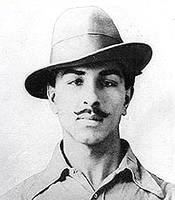 Though portrayed as a terrorist by the British, Sardar Bhagat Singh was critical of the individual terrorism which was prevalent among the revolutionary youth of his time and called for mass mobilization. Bhagat Singh gave a new direction to the revolutionary movement in India. He differed from his predecessors on two counts. Firstly, he accepted the logic of atheism and publicly proclaimed it. Secondly, until then revolutionaries had no conception of post-independence society. Their immediate goal was destruction of the British Empire and they had no inclination to work out a political alternative. Bhagat Singh, because of his interest in studying and his keen sense of history gave revolutionary movement a goal beyond the elimination of the British. A clarity of vision and determination of purpose distinguished Bhagat Singh from other leaders of the National Movement. He emerged as the only alternative to Gandhi and the Indian National Congress, especially for the youth.
Bhagat Singh was born in a Sikh family in village Banga in Layalpur district of Punjab (now in Pakistan). He was the third son of Sardar Kishan Singh and Vidyavati. Bhagat Singh's family was actively involved in freedom struggle. His father Kishan Singh and uncle Ajit Singh were members of Ghadr Party founded in the U.S to oust British rule from India. Family atmosphere had a great effect on the mind of young Bhagat Singh and patriotism flowed in his veins from childhood.
While studying at the local D.A.V. School in Lahore, in 1916, young Bhagat Singh came into contact with some well-known political leaders like Lala Lajpat Rai and Ras Bihari Bose. Punjab was politically very charged in those days. In 1919, when Jalianwala Bagh massacre took place, Bhagat Singh was only 12 years old. The massacre deeply disturbed him. On the next day of massacre Bhagat Singh went to Jalianwala Bagh and collected soil from the spot and kept it as a memento for the rest of his life. The massacre strengthened his resolve to drive British out from India.
In response to Mahatma Gandhi's call for non-cooperation against British rule in 1921, Bhagat Singh left his school and actively participated in the movement. In 1922, when Mahatma Gandhi suspended Non-cooperation movement against violence at Chauri-chaura in Gorakhpur, Bhagat was greatly disappointed. His faith in non violence weakened and he came to the conclusion that armed revolution was the only practical way of winning freedom. To continue his studies, Bhagat Singh joined the National College in Lahore, founded by Lala Lajpat Rai. At this college, which was a centre of revolutionary activities, he came into contact with revolutionaries such as Bhagwati Charan, Sukhdev and others.
To avoid early marriage, Bhagat Singh ran away from home and went to Kanpur. Here, he came into contact with a revolutionary named Ganesh Shankar Vidyarthi, and learnt his first lessons as revolutionary. On hearing that his grandmother was ill, Bhagat Singh returned home. He continued his revolutionary activities from his village. He went to Lahore and formed a union of revolutionaries by name 'Naujavan Bharat Sabha'. He started spreading the message of revolution in Punjab. In 1928 he attended a meeting of revolutionaries in Delhi and came into contact with Chandrasekhar Azad. The two formed 'Hindustan Samajvadi Prajatantra Sangha'. Its aim was to establish a republic in India by means of an armed revolution.
In February 1928, a committee from England,
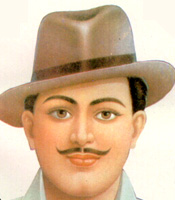 called Simon Commission visited India. The purpose of its visit was to decide how much freedom and responsibility could be given to the people of India. But there was no Indian on the committee. This angered Indians and they decided to boycott Simon Commission. While protesting against Simon Commission in Lahore, Lala Lajpat Rai was brutally Lathicharged and later on succumbed to injuries. Bhagat Singh was determined to avenge Lajpat Rai's death by shooting the British official responsible for the killing, Deputy Inspector General Scott. He shot down Assistant Superintendent Saunders instead, mistaking him for Scott. Bhagat Singh had to flee from Lahore to escape death punishment.
Instead of finding the root cause of discontent of Indians, the British government took to more repressive measures. Under the Defense of India Act, it gave more power to the police to arrest persons to stop processions with suspicious movements and actions. The Act brought in the Central Legislative Assembly was defeated by one vote. Even then it was to be passed in the form of an ordinance in the "interest of the public." Bhagat Singh who was in hiding all this while, volunteered to throw a bomb in the Central Legislative Assembly where the meeting to pass the ordinance was being held. It was a carefully laid out plot, not to cause death or injury but to draw the attention of the government, that the modes of its suppression could no more be tolerated. It was decided that Bhagat Singh and Batukeshwar Dutt would court arrest after throwing the bomb.
On April 8, 1929 Bhagat Singh and Batukeshwar Dutt threw bombs in the Central Assembly Hall while the Assembly was in session. The bombs did not hurt anyone. After throwing the bombs, Bhagat Singh and Batukeshwar Dutt, deliberately courted arrest by refusing to run away from the scene. During his trial, Bhagat Singh refused to employ any defence counsel. In jail, he went on hunger strike to protest the inhuman treatment of fellow-political prisoners by jail authorities. On October 7, 1930 Bhagat Singh, Sukh Dev and Raj Guru were awarded death sentence by a special tribunal. Despite great popular pressure and numerous appeals by political leaders of India, Bhagat Singh and his associates were hanged in the early hours of March 23, 1931.

Subhas Chandra Bose
Died: August 18, 1945
Achievements: Passed Indian Civil Services Exam; elected Congress President in 1938 and 1939; formed a new party All India Forward block; organized Azad Hind Fauj to overthrow British Empire from India.
Subhas Chandra Bose, affectionately called as Netaji, was one of the most prominent leaders of Indian freedom struggle. Though Mahatma Gandhi and Jawaharlal Nehru have garnered much of the credit for successful culmination of Indian freedom struggle, the contribution of Subash Chandra Bose is no less. He has been denied his rightful place in the annals of Indian history. He founded Indian National Army (Azad Hind Fauj) to overthrow British Empire from India and came to acquire legendary status among Indian masses.
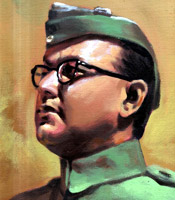 Subhas Chandra Bose was born on January 23, 1897 in Cuttack, Orissa. His father Janaki Nath Bose was a famous lawyer and his mother Prabhavati Devi was a pious and religious lady. Subhas Chandra Bose was the ninth child among fourteen siblings. Subhas Chandra Bose was a brilliant student right from the childhood. He topped the matriculation examination of Calcutta province and graduated with a First Class in Philosophy from the Scottish Churches College in Calcutta. He was strongly influenced by Swami Vivekananda's teachings and was known for his patriotic zeal as a student. To fulfill his parents wishes he went to England in 1919 to compete for Indian Civil Services. In England he appeared for the Indian Civil Service competitive examination in 1920, and came out fourth in order of merit. However, Subhas Chandra Bose was deeply disturbed by the Jallianwalla Bagh massacre, and left his Civil Services apprenticeship midway to return to India in 1921
After returning to India Netaji Subhash Chandra Bose came under the influence of Mahatma Gandhi and joined the Indian National Congress. On Gandhiji's instructions, he started working under Deshbandhu Chittaranjan Das, whom he later acknowledged his political guru. Soon he showed his leadership mettle and gained his way up in the Congress' hierarchy. In 1928 the Motilal Nehru Committee appointed by the Congress declared in favour of Domination Status, but Subhas Chandra Bose along with Jawaharlal Nehru opposed it, and both asserted that they would be satisfied with nothing short of complete independence for India. Subhas also announced the formation of the Independence League. Subhas Chandra Bose was jailed during Civil Disobedience movement in 1930. He was released in 1931 after Gandhi-Irwin pact was signed. He protested against the Gandhi-Irwin pact and opposed the suspension of Civil Disobedience movement specially when Bhagat Singh and his associates were hanged.
Subash Chandra Bose was soon arrested again under the infamous Bengal Regulation. After an year he was released on medical grounds and was banished from India to Europe. He took steps to establish centres in different European capitals with a view to promoting politico-cultural contacts between India and Europe. Defying the ban on his entry to India, Subash Chandra Bose returned to India and was again arrested and jailed for a year. After the General Elections of 1937, Congress came to power in seven states and Subash Chandra Bose was released. Shortly afterwards he was elected President of the Haripura Congress Session in 1938. During his term as Congress President, he talked of planning in concrete terms, and set up a National planning Committee in October that year. At the end of his first term, the presidential election to the Tripuri Congress session took place early 1939. Subhas Chandra Bose was re-elected, defeating Dr. Pattabhi Sitaramayya who had been backed by Mahatma Gandhi and the Congress Working Committee. Clouds of World War II were on the horizon and he brought a resolution to give the British six months to hand India over to the Indians, failing which there would be a revolt. There was much opposition to his rigid stand, and he resigned from the post of president and formed a progressive group known as the Forward Block.
Subhas Chandra Bose now started a
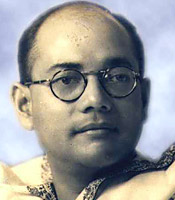 mass movement against utilizing Indian resources and men for the great war. There was a tremendous response to his call and he was put under house arrest in Calcutta. In January 1941, Subhas Chandra Bose disappeared from his home in Calcutta and reached Germany via Afghanistan. Working on the maxim that "an enemy's enemy is a friend", he sought cooperation of Germany and Japan against British Empire. In January 1942, he began his regular broadcasts from Radio Berlin, which aroused tremendous enthusiasm in India. In July 1943, he arrived in Singapore from Germany. In Singapore he took over the reins of the Indian Independence Movement in East Asia from Rash Behari Bose and organised the Azad Hind Fauj (Indian National Army) comprising mainly of Indian prisoners of war. He was hailed as Netaji by the Army as well as by the Indian civilian population in East Asia. Azad Hind Fauj proceeded towards India to liberate it from British rule. Enroute it lliberated Andeman and Nicobar Islands. The I.N.A. Head quarters was shifted to Rangoon in January 1944. Azad Hind Fauj crossed the Burma Border, and stood on Indian soil on March 18 ,1944.
However, defeat of Japan and Germany in the Second World War forced INA to retreat and it could not achieve its objective. Subhas Chandra Bose was reportedly killed in an air crash over Taipeh, Taiwan (Formosa) on August 18, 1945. Though it is widely believed that he was still alive after the air crash not much information could be found about him.
Tuesday, May 12, 2009
Che Guevara

Nickname "Che" derived from Guevara's habit of punctuating his speech with the interjection che, a common Argentine expression for a friend or hey! Ernesto Guevara de la Serna was born in Rosario, Argentina into a middle-class family of Spanish-Irish descent. Celia de la Serna y Llosa, his mother, had lost her parents while she was still a child. Celia was raised by her religious aunt and her older sister, Carmen de la Serna, who married in 1928 the Communist poet Cayetano Córdova Itúrburu. Guevara's family was liberal, anti-Nazi and anti-Peronist, and not very religious. With Celia's fortune, the family lived comfortably, although Ernerto Guevara Lynch, Ernesto's father, managed to spend much of it in his unlucky business ventures. In his youth Guevara read widely and among his reading list in the 1940s were Sartre, Pablo Neruda, Ciro Alegría, and Karl Marx's Das Kapital. He also kept a philosophical diary and in Africa 1965 Guevara planned to write a biography of Marx. In 1953 Guevara graduated from the University of Buenos Aires, where he was trained as a doctor. During these years Guevara read Stalin and Mussolini but did not join radical student organizations. He made long travels in Argentinaand in other Latin America countries. At the same time his critical views about the expanding economic influence of the United States deepened. In 1952 he made journey with his motor bike, an old Norton 500 single, around South America. The journey opened his eyes about the situation of the Indians and was crucial for the awakening of his social conscience. Like Jack Kerouac later in his book On the Road (1957), Guevara recorded his impressions in The Motorcycle Diaries. "The person who wrote these notes died the day he stepped back on Argentine soil," Guevara wrote in his diary. "Wandering around our 'America with a capital A' has changed me more than I thought." |
)
)
)
)
From 1961 to 1965 Guevara was minister for industries, and director of the national bank, signing the bank notes simply 'Che'. He traveled widely in Russia, India and Africa, meeting the leading figures of the world, among others Jawaharel Nehru and Nikita Khruschev. Guevara was also the architect of the close relations between Cuba and the Soviet Union. Although good relationships with Moscow become the cornerstone of Castro's foreign policy, Guevara followed the emergence of the Maoists. In 1965 Guevara made public his disappointments in Algiers and described the Kremlin as "an accomplice of imperialism". Guevara's dismissal from the ministry followed immediately on his return from Algiers. To test his revolutionary theories Guevara resigned from his post as a politician. He had published highly influential manuals Guerrilla Warfare (1961) and Guerrilla Warfare: A Method (1963), which were based on his own experiences and partly chairman Mao Zedong's writings. President John F. Kennedy had Guerrilla Warfare rapidly translated for him by the CIA. Guevara stated that revolution in Latin America must come through insurgent forces developed in rural areas with peasant support. The is no need for right precondition for revolution - guerrilla warfare can begin the activities. In his last article, 'Vietnam and World Struggle', Guevara outlined his global perspectice for revolutionary struggle, and stressed the dual role of hate and love. "And he did have a saving element of humor. I possess a tape of his appearance on an early episode of "Meet the Press" in December 1964, where he confronts a solemn panel of network pundits. When they address him about the "conditions" that Cuba must meet in order to be permitted the sunshine of American approval, he smiles as he proposes that there need be no preconditions: "After all, we do not demand that you abolish racial discrimination…." A person as professionally skeptical as I.F. Stone so far forgot himself as to write: "He was the first man I ever met who I thought not just handsome but beautiful. With his curly reddish beard, he looked like a cross between a faun and a Sunday-school print of Jesus…. He spoke with that utter sobriety which sometimes masks immense apocalyptic visions." (Christopher Hitchens in New York Review of Books, July 17, 1997) During his disappearance from public life Guevara spent some time in Africa organizing the Lumumba Battalion which took part in the Congo civil war. He was not happy how Laurent Kabila fought against Joseph Mobutu, although his first impression on Kabila was positive. "Africa has a long way to go before it reaches real revolutionary maturity," Guevara concluded in his diary. In 1966 Guevara turned up incognito in Bolivia where he trained and led a guerrilla war in the Santa Cruz region. In his manual Guerrilla Warfare, Guevara had stressed that the guerrilla fighter needs full help from the people of the area, it is an indispensable condition, but Guevara failed to win the support of the peasants and his group was surrounded near Vallegrande by American-trained Bolivian troops. "The decisive moment in a man's life is when he decides to confront death," Guevara once said. "If he confronts it, he will be a hero whether he succeeds or not. He can be a good or a bad politician, but if he does not confront death he will never be more than a politician." After Guevara was captured, Captain Gary Prado Salmón put a security around him to be sure that nothing happened. Guevara told him, "don't worry, captain, don't worry. This is the end. It's finished." (from the document film 'Red Chapters,' 1999) Guevara was shot in a schoolhouse in La Higuera on October 9, 1967, by Warrant Officer Mario Terán of the Bolivian Rangers at the request of Colonel Zenteno. Terán was half-drunk, celebrating his borthday. Guevara's last words were according to some sources: "Shoot, coward you are only going to kill a man." In order to make a positive fingerprint comparison with records in Argentina, Guevara's hand were sawed off and put into a flask of formaldehyde. They were later returned to Cuba. Guevara's corpse was buried in a ditch at the end of the runway site of Vallegrande's new airport. "Che considered himself a soldier of this revolution, with absolutely no concern about surviving it," said Fidel Castro later in Che: A Memoir. Che Guevara did have some last words before his death; he allegedly said to his executioner: "I know you are here to kill me. Shoot, coward, you are only going to kill a man." Víctor Pérez-Galdós, Un hombre que actúa como piensa, Editora Política, La Habana, 1988. Paco Ignacio Taibo II, Ernesto Guevara, también conocido como el Che, Editorial Joaquín Mortiz, México, 1996. |
Thursday, April 9, 2009
Winston Churchill

Winston Churchill: Defender of Democracy.
The rows were explosive, the challenges enormous, but Churchill led Britain through World War Two with unique assurance - his cigar always in place. 'Winnie' changed his country's military approach from defensiveness to aggressive attack, and so altered the course of history. The historian Geoffrey Best describes how he did it.A statesman transformed
At the beginning of the Second World War the reputation of Winston Churchill was that of a gifted politician who had twice changed parties, an impulsive man prone to impractical enthusiasms, and a Conservative backbencher who opposed the foreign policy of his leader - the prime minister, Neville Chamberlain.
Six years later, Churchill towered above all contemporaries as a statesman of international renown. He was known as the champion of freedom and civilisation, and the victorious leader of the British nation and empire at war. How did this transformation happen?
The change did not begin to happen until 1940, when the war was nine months old. Even his enemies had recognised that Churchill would have to be brought into the government in the event of war - his military expertise was universally acknowledged, and his criticisms of Chamberlain's policy of appeasement had after all proved justified - and he had been made First Lord of the Admiralty. In this capacity he was given charge only of the Royal Navy, a position that, after ten years in the political wilderness, he was content to accept.
Had the war ended before May 1940 (as some people wanted it to do, although it would have meant sacrificing Poland in the wake of Czechoslovakia), history would now know Churchill as an average First Lord, with an embarrassing share of responsibility for the failures of the Norwegian campaign. But by a strange turn of history, this failure led to the increased unpopularity of Chamberlain, and gave Churchill his big chance. On 8th May 1940, the Commons began to debate the government's poor performance in the campaign. Then on the 10th, Germany began its invasions of the Low Countries and France - the 'phony war' was over.
Threat of invasion
Chamberlain resigned, the man whom most Conservatives wanted in his place (Lord Halifax) declined to serve, and Churchill took on the job. It was astonishing, and a measure of his uniqueness, that he did so with calm assurance and a conviction that this, at last, was the realisation of his destiny: to lead his beloved nation in an all-out war for survival and for the universal values it represented.If the challenge looked formidable on 10th May, it looked infinitely worse six weeks later. The British army's escape from capture at Dunkirk was hailed as a salvation but of course it was, in military terms, a shocking setback. The continental ally whom Britain had relied on to face the German army had surrendered, Italy had come in on the German side, and Hitler was master of Europe from the Arctic Circle to the Bay of Biscay.
In addition, the French navy was likely to fall into German hands, German U-boats would soon have bases on the Atlantic, German bombers would be able to take off from bases close to Britain's coasts, and, worst of all, now that the Germans were able to mass on the Belgian coast, Britain was facing the first serious threat of invasion since 1805. It was easy in such circumstances to despair and to look for a way out of a war that seemed impossible to win.
Any leader but Churchill would probably have done so - with no other imaginable consequence than that Britain would have become (like Vichy France) a subordinate cog in Hitler's imperial machinery, with a subservient right-wing authoritarian government dedicated to racial discrimination. Churchill, however, saved his country from that humiliation.
Unfailingly brave
Churchill persuaded cabinet and parliament that Britain and its empire could survive. His inspiring speeches encouraged the British people to be courageous and hopeful, and he invited the rest of the world - especially the United States, whose support he hoped to secure - to back them up. He forbade defeatist talk and refused to be put on the defensive. Even in those fraught days, he ordered planning to begin for attacking German power by means of heavy bombing, commando raids, and the Special Operations Executive (SOE)-aided resistance by Germany's victims.His public demeanour was unfailingly brave and heartening. The Conservative Party came round to him, the British people (except for the communists) were solidly behind him; and by the end of October the worst of the dangers of that year were past. The 'Battle of Britain' had been won (though only just), invasion was no longer imminent, and Londoners were beginning (painfully) to learn how to survive 'the Blitz'.
Having successfully brought his people through that baptism of fire, Churchill now had to manage a war that was going to be long and hard. Despite his years (he was approaching 70 by now), he proved to be very good at it, earning universal respect as one of the most remarkable war leaders of modern history.
Man of the people
The first of the four fields in which he had to lead was, literally, the popular one. The British people had to be kept united. The impression they got of their leader would be crucial. Churchill remained as heartening, even endearing, a figure through the years 1941-45 as he had been in 1940. He was a popular character, an eccentric of traditional type. His sonorous and rousing speeches were unlike anyone else's, and his manner of delivery lent itself to admiring imitation. Except when dressing up as a warrior, he wore distinctive clothes: old-fashioned pinstripes with a bow tie, or funny clothes like the 'siren suits' his wife got made for him. He was often seen, never without his cigar, around the cities of Britain and wherever the armed forces were encamped. Good stories were told (or made up) about him and people familiarly referred to him as Winston or 'Winnie'. He appeared to be a man of the people.Besides being a popular leader, Churchill was also an emphatically democratic one. Parliament continued to sit throughout the war, and the war's progress was publicly debated. Churchill assumed full responsibility and, during the dark months of 1941-42, when he often had to report disasters, he had to bow a bit to his critics. The normal peacetime freedoms of the citizen were of course restricted but rarely beyond the limits of reason. The world could see no hypocrisy in Churchill's claim to be fighting for democracy and human rights against tyranny and barbarism.
Grand alliance
In foreign affairs, his greatest achievement was to engage the sympathy of the United States, without whose material help - and, better, military alliance - Britain, he well understood, had no chance of winning. America came safely on board in December 1941. A more unexpected ally had already been found in the form of the Soviet Union: an uncomfortable ally, indeed - but given Britain's grim situation in mid-1941, Churchill prudently bowed to necessity. Once this 'grand alliance' was formed, Churchill became both the pivot and mainspring of it. Stalin and Roosevelt, left to themselves, would never have come together to decide grand strategy and to try to sort out problems. It was Churchill who did the journeying (40,000 miles during the war) to keep the 'big three' together; it was he who invented the 'summit' meetings of national leaders (those at Teheran, Yalta and Potsdam are the most famous) - and these have remained a feature of international affairs ever since.The fourth dimension of Churchill's war leadership, the one that continues to excite more debate than the others, concerned the military. Constitutional principle, joined with his experience of the First World War, convinced him that military men could not be allowed to use their armed forces free from ultimate civilian political control. Britain's military chiefs for their part sought no such freedom; but they did expect freedom to decide by themselves, with the advice of their own staffs and experts, what was militarily possible and what was not. Churchill, a soldier himself in earlier life and with naval experience, liked to press his own ideas upon the army and navy staffs and insisted on them being exhaustively considered. This wasted much time and temper. The memoirs of the army Chief of Staff, Lord Alanbrooke, are only the most choleric of many accounts of the rows that punctuated the army's relations with its ultimate master.
Achievements of war
There is no doubt some of Churchill's ideas were impractical, even silly. On the other hand, some were good, and others were politically necessary. He was surely right, moreover, to believe that the generals tended to plan too stolidly and move too slowly, and that without his zeal for aggressive activity early on, the British armed forces would have lapsed into mere defensiveness. When large-scale offensives did become practical, in 1943, his big idea was, oddly enough, one that appealed to Alanbrooke: the idea of attacking Germany through Italy and, if possible, the Balkans.Undertaken with maximum force, this would have been at the expense of the 1944 Normandy landings upon which the Americans had fixed their aim. Whether Churchill's 'Mediterranean strategy' was a good or a bad idea remains controversial; as do the questions of whether more or less resources should have been put into the costly bombing offensive gallantly conducted by the RAF, encouraged by Churchill, and of the rights and wrongs of its methods. In this fourth dimension of his leadership, one has to conclude that Churchill's achievement was not as indisputably great as in the other three. But overall, as is almost universally agreed, his achievement in the war to save democracy and the liberties of Western Europe was enormous.