

The last days of the year 1931, in the Central Jail at Vellore. A number of freedom fighters were imprisoned there. Some of them were sitting under a tree in the open yard. As they were chatting, a lean man, wearing dark glasses, and trying to tighten the dhoti he was wearing, walked across the courtyard. The men who were squatting under the tree stood up respectfully.
"Who is that?" one of them asked.
"You don’t know? He is Rajaji, the man who is worthy of being our Governor General" replied Professor N.G. Ranga, who happened to be there.
About seventeen years later, Rajaji did become India's Governor General.
The Governor General
The fifteenth of August 1947.The shackles of India's political slavery were at lasting broken. The country became independent. The determined fight under leaders like Mahatma Gandhi, Sardar Patel and Nehru forced the British to quit India. For a few months, Lord Mountbatten was the last British Governor General. He was to return to England in June 1948.
An Indian had to take over as the Governor General.
'The Post of the Governor General of free India is really a very high one. Who can worthily fill it? This was the question every where. All eyes turned to Rajaji. Rajaji became free India's first Indian Governor General.
He held the reins of administration for some twenty months and proclaimed India
a Republic on January 26, 1950.
Rajaji was a great patriot, an unequalled statesman, a great social reformer, an
able administrator, a popular writer, freedom fighter, an intimate associate of
Mahatma Gandhi, one of the makers of modern India, a great leader of the Gandhian era and the founder of the Swatantra Party.
The Chakravarti Family
Rajaji's real name was Chakravarti Rajagopalachari. People affectionately called him Rajaji.
How the family got the name of Chakravarti is an interesting story. In Sanskrit, 'Chakravarti' means the King of Kings. Once when an ancestor of Rajaji was bathing in the river near their village, he saw a dead body come floating down the river. Fearing that if left so to float, vultures would only eat up the body, he pulled it out of the river and cremated it. But later, it became known that the dead body was that of a Harijan, considered by Hindus as an outcast. Hence the Brahmins of the village expelled him. One day he had to perform an annual ceremony in memory of a dead ancestor. Such days are very sacred to Brahmins. But no Brahmins would agree to go to his house and partake of the ritualistic meal. Rajaji's ancestor was in great grief and anguish. Just then a person came along and said he was a Brahmin; he said he would perform the worship in that house and partake of the meal. As he was about to leave, he blessed the householder saying "Nallan Chakravarti" meaning a good Emperor. Then he vanished. The people who were they’re thought he was no ordinary mortal, but a super human being. From then on this family got the name of Chakravarti family. So goes the story.
Prosperous Lawyer
Rajaji was born on December 8, 1878 in Thorapalli Village near Hosur in Salem District of Tamilnadu. His mother was Shringaramma. His father Chakravarti lyengar was not only the village munsiff but also a great scholar in the Vedas, Puranas, and other Sanskrit lore. Rajaji completed his primary education in his native village and then joined the District Board High School at Hosur. Later he passed the B.A. degree examination from the Central College in Bangalore and secured a Law Degree in Madras.
When he was studying in the Law College in Madras, an interesting incident happened.
Swami Vivekananda visited Madras. He was put in the very hostel where Rajagopalachari was staying. Going round the rooms of the students in the hostel, he entered Raja- gopalachari's room. He saw on the wall a picture of Lord Krishna. He asked, "Why is Lord Sri Krishna blue in hue?" Raja- gopalachari, still a student, answered: "Sir, the sea is limitless. So is the sky. And both are blue. God is also boundless. And so His hue is also blue."
Swami Vivekananda was overjoyed. He said the young boy would rise to eminence and would become very famous.
It was in Salem that Rajaji began independent practice as a lawyer. He was just twenty years old. He came to be known as an expert in conducting criminal cases. He was so skilful that he won even very complicated cases quite easily.
Soon Rajaii became very famous as an advocate in Salem. He was the very first person there to own a car. When he was twenty, he married Alamelu Mangammal.
When he was just twenty-one, he conducted very difficult cases independently. His knowledge of law, his intelligence and his fearlessness brought him great fame and wealth in a short time.
Just then, the Government had prosecuted a patriot by name Varadarajulu Naidu; the charge was that he had spoken against the Government. Rajagopalachari was the advocate for Varadarajulu Naidu. Whenever Rajaji stood up to speak, the judge would say "Please sit down." Next day, at the very outset Rajaji stood up and made a submission: "I have great respect for the Honorable Judge. But if like a teacher in a classroom, Your Honor always asks me to sit down, I shall not be able to discharge my duty; and it will not add to the dignity of this court." The Judgeapologized to Rajaji. Finally, on the basis of Rajaji's arguments, Varadarajulu Naidu was acquitted.
The Municipal President
Rajaji believed that the individual was part of society and must make his contribution to social life. In 1917 he becamePresident of the Municipal Council in Salem. No sooner, did he become President than the work of the local body got a new impetus. He started adult education classes and also night schools for factory workers. Schools for Harijans were also opened. Rajaji appointed a committee to prepare a glossary (list of difficult words) in Tamil so those science subjects could be taught in that language. He also drew up a plan for the supply of water to Harijans. A Master plan for the development of Salem was also formulated.
Rajaji did much to better the lot of the Harijans. When he admitted Harijan students into a hostel, even some elders whom he respected very much opposed him. But Rajaji did not relent or retreat.
With National Leaders
Even from his student days, Rajaji was interested in politics. During those days he had the good fortune of being guided by great men like Chidambaram Pillai and Subrahmanya Bharati. He came under the influence of leaders who were trying to awaken the Indian people from slavery. Annie Besant, Bala Gangadhara Tilak and
others began to appreciate Rajaji. That Rajaji entered the political arena was not surprising. In 1916, the Government of India arrested Annie Besant. When the train carrying her came to Salem, people gathered in a large numbers to see her. But the authorities would not permit it. Then the people squatted on the rail track.
The Collector of Salem called in the police and was about to order them to open fire. Rajaji talked to him, argued, and guaran- teed that the people would be orderly and nonviolent. Then the gathering offered garlands to Annie Besant and showed its gratitude. Rajaji later argued on behalf of Annie Besant in the law court, and she was released.
In South Africa, the Government and the Whites were treating non-White population like dirt under their feet. Gandhiji put up a tremendous struggle against that. It was on account of the Satyagraha conducted there that Gandhi’s extraordinary quality of leadership came to the limelight. When Gandhiji returned to India, Rajaji also accepted his leadership.
Rajaji suggested to the then Editor of The Hindu, Kasturi Ranga Iyengar, that Gandhiji be invited to Madras. An invitation was accordingly sent to Gandhiji. When Gandhiji came, he stayed in Rajaji's house. For sometime Gandhiji could not make out that it was Rajaji who had invited him and that he was in Rajaji's house. The way
Rajaji conducted himself, Gandhiji thought that he too was a guest!
Against Untouchability
Rajaji held that the removal of Untouch- ability was very important. He admitted Harijans to the "Gandhi Ashram" which he founded. His cook was a washerman.
Once it happened that a Harijan devotee entered a temple. He had religious ash- marks on his forehead and arms and was singing hymns. Some fanatics prosecuted him in a court of law. Reading about it in the newspapers, Rajaji was pained. He took up his case in the court and argued on his behalf.
In those days Harijans were not allowed to enter temples. Rajaji tried very hard to see that" a bill removing this disability was passed in the Madras and Central Legis- latures. But he did not Succeed. Rajaji was the first to work for legislation for the removal of Untouchability. He had to face intense opposition and many obstacles. But he was undaunted.
Rajaji never cared for caste restrictions. He gave his daughter Lakshmi in marriage to Gandhi’s son Devadas.
In the Whirligig of Politics
Rajaji's political life had a strange course. He was the General Secretary of the Indian National Congress in 1921-22. For two decades from 1922, he continued as a working committee member. He became a frontline leader of the Congress, and was a confidant of Gandhiji. His extraordinary genius was well known to all. He participated in various Satyagraha movements and was imprisoned fivetimes. When Gandhiji began the salt Satyagraha, Rajaji led a procession from Tiruchirapalli to Vedaranya and began making salt on the seashore. They were all arrested by Government and sent to prison.
When, for the first time, the Congress participated in the elections, Rajaji became the Chief Minister of the then Madras Province. But he resigned from the Congress in 1942. The Muslim League under Jinnah put forth the demand for Pakistan. It insisted that grouping together Muslim majority provinces and dividing India into two should create a separate nation. In the early stages the Congress opposed the demand. But Rajaji said that it was better to accept the demand for Pakistan. Many Congressmen criticized Rajaji very harshly. Rajaji left theCongress. But the same Congress agreed to the demand for Pakistan in 1946!
Rajaji again joined the Congress in 1945. He became a Minister when Jawaharlal Nehru formed a Government on the eve of independence. The state of West Bengal had certain serious problems.
Rajaji became the Governor of that State in 1947. When Lord Mountbatten returned to England, Rajaji became the Governor General occupying the highest position in free India. Later, he was Home Minister in the Central Government. By then he was 72 years old, and he needed rest. He gave up the Ministership and returned to Madras and the world of letters. He began a study of the Ramayana.
A little later, when the Congress Party in Madras again urged him to take up the leadership, he said, "No. I am old, and I do not want any power or responsibility." But finally he had to agree and in 1952, at the age of 75 years, he became the Chief Minister. He infused a new dynamism into the Congress before retiring. But he became disgusted with the way the country's affairs were going on. He felt that in the havoc created by the control-licence -raj, corruption became rampant and the nation's life was in a shambles. It became clear that if there were no strongopposition party in a democracy, it would only be a travesty of democracy. So, the 82-year-old hero founded a new party called "The Swatantra Party". It was the main opposition party in the Lok Sabha till 1969.
Prison and Politics
Rajaji hated sloth- even when he was kept in prison, he converted it into a school. He gave of his knowledge to his co-prisoners. He would recount the stories of the Ramayana and the Mahabharata to them. Not only did he seriously study many a book in prison, but he wrote some books too. It was in prison that he wrote his book on the ancient Greek philosopher, Socrates. It became a famous work.
Many a time when there were quarrels between the prisoners and the officials of the goal and the situation became tense, Rajaji would step in as peacemaker. So even the prison officials had greataffection and regard towards Rajaji.
A feeling has grown that politics means competition and hatred. But the way Rajaji conducted himself in politics was remark- able.The well-known leader Satyamurty and Rajaji belonged to opposite groups in politics. Still whenRajaji was giving up the Presidentship of the provincial congress committee, he tried hard to see that Satyamurty was greatly surprised by knowing this thing. He freely praised Rajaji and said, "I never knew that Rajaji had a heart of gold!"
Satyamurty was the only leader who had not courted arrest even sometime after Gandhiji began the Non Co-operation Movement in 1930. All other leaders of Madras were in goal. Rajaji went straight to Satyamurty, though he was his political opponent. He told him, "All other leaders of Madras have gone to goal. It is a question of the prestige of Madras. So you must also participate in the Satyagraha now." Satyamurty agreed. Both of them picketed before a shop selling foreign cloth and courted arrest. That was the first stretch of prison life to Satyamurty.
Simple Life
Rajaji lived in an utterly simple way throughout his life. He had inherited property. Within a couple of years after enrolment as a lawyer, he was earning two to three thousand rupees a month. But he lived a very simple life. He never left the path of virtue. His life was dedicated to righteousness. He was like Bhishma in
righteousness, and in statecraft like Chanakya.
Rajaji always wore Khadi. He firmly believed in the need to use Khadi and Swadeshi articles. Even when he was in prison, he used to spin for a few hours every day. As for his clothes, he wore a dhoti, a jubba (a loose, long shirt) and a shawl on his shoulders. That was all. And he wore dark glasses. He had to wear them always because of some eye ailment. Someone once asked him about it. Rajaji humorously said, "When I meet anybody, I must look at him well and know about him. But he should not see in my eyes what I think of him. So I wear these dark glasses."
The Fearless Hero
There were three prominent traits in Rajaji. The first was fearlessness. Never would he refrain from saying or doing what he thought was correct because it might displease someone or it might be unpopular or those in power mightbecome angry. When he was yet very young, he was an admirer of a Swamiji by name Sahajananda, who was a Harijan. When the Swamiji came to Salem, Rajaji and his friends arranged a dinner for him. Some orthodox persons became wild with anger at this, and they ex-communicated Rajaji and his friends. The priests would not go to their Houses to officiate at religious functions. But Rajaji remained undaunted by any of these things. When he went to Bombay in 1941, he had to face a black- flag demonstration against him. Some threw stones at him in the public meeting. But Rajaji did make his speech. In just a few minutes, there was calm and the people listened to him.
Rajaji had unflinching faith in Mahatma Gandhi’s philosophy and principles. He always followed them. He was also very close to Gandhiji. When an association was started in Madras to explain to the people, the philosophy behind Gandhi’s method of Satyagraha, Rajaji was chosen president of that body. Gandhiji was very happy when he heard of it. Of curse, Rajaji was not a man to accept the ideas and views of others without examining them. Gandhiji so even with the ideals preached it.
When the question of dividing the country arose, every Congress leader opposed it. Still Rajaji supported the demand for Pakistan. He kept aloof from the 'Quit India' movement started in 1942 to get the country's independence from the British. He was the only leader who did not take an active role in that movement. So he resigned from the Congress in 1942. Some accuse him of being the cause for the rise of Pakistan. He had to face the hostility of the people who thought that he supported the creation of Pakistan. It became difficult for him to speak in meetings. Quite a few leaders also criticized him harshly. But Rajaji faced not only harsh words but also stones, and justified opinion.
At the time Rajaji started the Swatantra Party, the Congress Party and Jawaharlal Nehru had tremendous influence in the country. But Rajaji did build this opposition party. And till his last day, whenever he felt that either the ruling party or very popular leader like Nehru was making a mistake, he roundly condemned it.
During the Second World War (1939-45), when it seemed the Japanese would bomb Madras in 1942, the Governor of Madras fled the city. The people also started appealed to them. This is our country, not of the British. They may run away. But in those days of run a teashop in the Hindi Prachar Sabha Bhavan.
An Extraordinary Genius
Secondly, Rajaji was an extraordinary genius. He was known for his sharp intellect. He could grasp any subject easily. He could pinpoint in a split-second the essence of any situation or problem. Because of such clear thinking and sharp understanding, his speech was also balanced, clear and to the point.
As an administrator he displayed dareness and a keen intelligence.
He was the Chief Minister of Madras in 1937. Then he introduced prohibition. This was being done for the very first time in India. But prohibition meant loss ofrevenue to Government. So he introduced Sales Tax for the first time. Many economists also welcomed the measure.
The farmers in our country were bowed and crippled by the weight of debts. Every farmer’s family was in debt, and the every interest on it was enough to ruin the family. A farmer was born as a debtor, and he lived as a debtor and finally died in the same conditions. To remove this pernicious evil, Rajaji brought in a new regulation. He banned the charging of unreasonably high interest.
As Chief Minister of Madras, Rajaji had laid for himself a very high code of conduct, others would have found it impossible to follow it. He exercised great caution to see that he and his Ministers remained untouched by corruption. He always went to the State Legislative Assembly ready to answer any question or supplementary.
He had asked other ministers also to be similarly prepared.
In 1952, Rajaji again became the Chief Minister of Madras. He removed allcontrols on foodgrains. Several Ministers at the Center and also others thought that Rajaji had taken a wrong and hasty step. But soon it was evident that what he did was right. So all over the country, the controls on foodgrains were removed. Two years later he felt that the educational system in the State should be radically changed. There was great opposition to this. So he resigned.
Service-minded
The third important trait in Rajaji was his service-mindedness. He had become quite rich while quite young. If he had continued as a lawyer and had not entered politics, he could have been very wealthy. He could have led a life of luxury. He gave up such a career for the sake of the country. He went to goal five times. Another Congress leader, Kaleswara Rao, has narrated how he became the Chief Minister of Madras. Rajaji never wanted any position. Vallabha Bhai Patel himself suggested that Rajaji should be the leader of the Party. "I do not want all that," said Rajaji. He just would not listen. Kaleswara Rao became angry. He said, "It is now your duty to lead the Party. If you do not wish to do your duty, why are you here? You can go anywhere.Go to theHimalayas. But this is not the place for you. Yes, please go away." Rao was shouting in fury. Finally, with great effort, Patel had to persuade Rajaji. As Governor General, he had held the highest position in the country. Any one else in his position would have said, "I was the Governor General of India. How can I accept a lower position?" But Rajaji had no such thought. Hebecame a Central Minister and later the Chief Minister of a state. When he felt that his work was over, he promptly laid down office. When he started the Swatantra
Party he was a very old man. He wanted no position for himself. Building up a new party meant hard work, he could expect no personal gain. But he felt that in a democracy there should be a strong opposition party. If there is no such party, the Government will Becomeirresponsible. So he started and nursed and built up the new party.
It was only once that Rajaji went outside India. Representing the Gandhi Peace Foundation, he visited Britain and the United States of America in 1961.
At that time, he was 83 years old. The old sage went out only to utter a few words of wisdom. Powerful nations of the world were competing among themselves; they wanted to make atom bombs and even more destructive weapons. Rajaji was troubled. He thought that if it went on, all mankind’s would be destroyed. So he wished to warn that even the mostpowerful nation must consider the welfare of humanity at large. He went as the leader of a mission, which wanted to appeal, that suicidal atomic experiments should stop. He talked to the then President of the United States, John F.Kennedy, for forty-five minutes. Kennedy later said that the discussion brought him the great influence of a pure and gentle culture.
Popular Writer
Rajaji was a very popular writer in Tamil and English, Some of his books have a unique place in the world of letters. He has also translated some Kannada stories into Tamil. He has written more than thirty books. His books on the ancient Roman King Marcus Aurelius, on the Bhagavad- Gita, the Ramayana, the Mahabharata and the Upanishads are all very famous. Even a common man can read and understand his writings. Rajaji said, "My books on the Ramayana and the Mahabharata are my greatest service to my people." There is no exaggeration in it. Their simple style is very attractive.
They are books, which every Indian should read and enjoy. By translating the Ramayana and the Mahabharata into simple and beautiful English, Rajaji has made it possible for the people of the Western countries to read and enjoy these great epics of India. The Mahabharata written in English by Rajaji is a textbook for Oriental Studies in five American Universities and more than three lakh copies of it have already been sold. Two lake copies of the Ramayana have been sold. Rajaji spoke and wrote very simple language. He was a great scholar, but his language was never pedantic. When people heard him speak, they were amazed that difficult and profound ideas could be expressed in such simple words. The same feeling comes when we read his books. Rajaji's stories have their own charm. He had a fine sense of humor. Even while speaking in the legislature, according to the situations he was telling some stories. He wrote many articles in the "Swarajya". He dealt with every subject in the country's affairs. Any article by him on any subject always presented a new
angle. It would make the readers think again. But the language was quite simple.
It was Rajaji who introduced teaching of Hindi compulsory in Madras. But twenty years later Rajaji himself led the agitation against Hindi. He felt strongly that in the eagerness to spread Hindi as the national language, the regional languages should not be adversely affected; their development should not be harmed.
Words of Wisdom
Like many a great person, Rajaji also could foresee the future. Even when he was in prison in 1921, he wrote in his diary; "Freedom will come; but immediately thereafter or even for a long time it may not bring the people happiness or a good government. As soon as freedom comes, there will be a scramble for electedplaces; in its wake will come corruption, injustice and the wickedness caused by money and an inefficient administration. The life of the people will be like hell. Many will feel that the older regime, which was comparatively more just, efficient and honest, was better. What we get from our independence will be only freedom from indignity andslavery. Our future lies in making our youngsters good citizens by giving them from early days an education, which is likely to create good conduct, righteousness and mutual love. If that is not done, it is certain that they will be crushed under the wickedness of injustice and wealth."
Many of Rajaji's ideas deserve serious consideration.
Rajaji had something interesting to say about celebrating birthdays. He felt that in our country we went too far in the matter of celebrating the birthdays of grown-up persons. Suppose we admire a leader we celebrate every birthday of his-the fifty- second, the fifty-third, the fifty-fourth and so on. Is this quite necessary? Suppose we celebrate his 50th birthday, his 60th birthday, his 70th birthday and so on. We shall be honoring him once in ten years. Is this not enough? It is different withchildren. There is nothing wrong in observing it every year for a little one. But there is certainly no propriety in observing the birth anniversaries of our grown-up leaders every year as we may do for children. We do go too far in declaring holidays. We seem to think that the best way to show respect for a great person or a great event is to give up work on that day. The folly is self-evident.
Rajaji never sought fame. He did not attach any importance to it. He knew that he was not exceptionally popular; he knew that quite often those who agreed with his views were very few. Once somebody mentioned this to him. Rajaji replied,"Our ancient sages did not give up their firm belief in their ideals just because they did not have many followers".
Some persons once went to Rajaji to discuss with him about the celebration of Gandhi’s birth centenary. Rajaji said, "But we do not see Gandhiji in the political, social or economic spheres in the country. In this state of affairs you are thinking of celebrating the Gandhi birth centenary. You are brave men!" There was a touch of humor, but the pain in his mind was obvious.
Not after Popularity or Happiness
Rajaji's interest in the affairs of the country and his concern for the future always remained the same. They did not diminish a whit till the very end of his long life. He was troubled deeply that people of the country were not happy, that moral standards were going down in public life and that persons in public life did not have
even basic honesty.
This unequalled intellectual passed away on December 25, 1972. He was then 94.
Rajaji received in his life both great honor and violent criticism. He heard theharshest words of criticism from his owncolleagues. People who could not understand him pelted stones at him. He withstood all that. And he was the Governor General of India. He was also the recipient of the highest award, the Bharata Ratna. Rajaji, who explained the meaning of the Bhagavad- Gita in his books, had imbibed its essence in his own life. Praise did not elate him; malicious words did not upset him. So many people reproached him saying that he encouraged the creation of Pakistan. Rajaji also did want an undivided India. But he came to the conclusion that India could not get freedom unless Pakistan was conceded to the Muslims. If some people want Pakistan, why keep them with us by force? Let us give them what they want let them experience the happiness or the misery or their new state. This is political wisdom. So ran his thoughts. Gandhiji himself once said, "If I had made over the leadership to Rajaji, I would not have had to see the bloodshed that occurred for the division of the country. He can see six months ahead of me."
Rajaji did not get much happiness in his family life. When he was just thirty-five his wife died. He was very young and also had a very good income. Many relatives and friends told him that he should marry again.
Rajaji, who had five children, said in his own humorous way, "If I marry again, I would have to look after the sixth child along with the five I have."
Constructive Work
Rajaji was proud of India. He had studied deeply the history of India, its literature and culture. His pride was rooted in this knowledge. He always thought of the welfare of the country. He worked for it in several ways. He practiced the teachings of Gandhiji. Gandhiji had told his followers that it was not enough to fight against the British, their sacred task included hard work for developing our motherland, Rajaji always wore Khadi, and never failed to spin even in prison. He set up and ran a Gandhi Ashram in a village called Pudupalayam. He supplied. Spinning wheels and cottons not only to those in the Ashram but also to people in the villages around. He made arrangements for the sale of the yarn spun by the villagers. There was a school in the Ashram. Quite often Rajaji was found teaching in the classes. His son, who was a doctor, attended on the people in the Ashram and the villages nearby. Rajaji periodically visited the villages. He arranged Jor the
digging of wells. He advised people to give up liquor. He started bee keeping in the Ashram and taught people to earn money in this way. He was convinced that the two great evils of Indian society were drinking and Untouchability, so he fought against them tirelessly when he was in power and later too. He was also responsible for starting over two hundred co-operatives.
A Child of India's Culture and a World Citizen
Rajaji was a child of Indian culture. At the same time he saw all mankind as one family. It seemed to him that selfishness and foolish notions of prestige blinded the powerful nations of the world. They were madly making most modernized weapons of mass destruction. They would plunge themselves and the whole of humanity in misery. Even in extreme old age, Rajaji tried to prevent this.
Rajaji was grieved that freedom did not bring happiness and joy to the people of India; he was unhappy that the greed for money and power was ruining national life. He was the center of a hundred controversies. Different people may find this or that view of Rajaji unacceptable. But there can be no difference of opinion that Rajaji was the most brilliant leader of India in the twentieth century, and one who spoke fearlessly for the weal of India and the World.


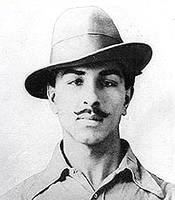 Though portrayed as a terrorist by the British, Sardar Bhagat Singh was critical of the individual terrorism which was prevalent among the revolutionary youth of his time and called for mass mobilization. Bhagat Singh gave a new direction to the revolutionary movement in India. He differed from his predecessors on two counts. Firstly, he accepted the logic of atheism and publicly proclaimed it. Secondly, until then revolutionaries had no conception of post-independence society. Their immediate goal was destruction of the British Empire and they had no inclination to work out a political alternative. Bhagat Singh, because of his interest in studying and his keen sense of history gave revolutionary movement a goal beyond the elimination of the British. A clarity of vision and determination of purpose distinguished Bhagat Singh from other leaders of the National Movement. He emerged as the only alternative to Gandhi and the Indian National Congress, especially for the youth.
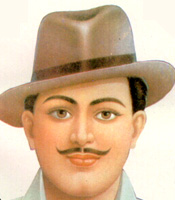 called Simon Commission visited India. The purpose of its visit was to decide how much freedom and responsibility could be given to the people of India. But there was no Indian on the committee. This angered Indians and they decided to boycott Simon Commission. While protesting against Simon Commission in Lahore, Lala Lajpat Rai was brutally Lathicharged and later on succumbed to injuries. Bhagat Singh was determined to avenge Lajpat Rai's death by shooting the British official responsible for the killing, Deputy Inspector General Scott. He shot down Assistant Superintendent Saunders instead, mistaking him for Scott. Bhagat Singh had to flee from Lahore to escape death punishment.
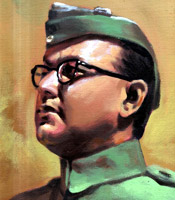 Subhas Chandra Bose was born on January 23, 1897 in Cuttack, Orissa. His father Janaki Nath Bose was a famous lawyer and his mother Prabhavati Devi was a pious and religious lady. Subhas Chandra Bose was the ninth child among fourteen siblings. Subhas Chandra Bose was a brilliant student right from the childhood. He topped the matriculation examination of Calcutta province and graduated with a First Class in Philosophy from the Scottish Churches College in Calcutta. He was strongly influenced by Swami Vivekananda's teachings and was known for his patriotic zeal as a student. To fulfill his parents wishes he went to England in 1919 to compete for Indian Civil Services. In England he appeared for the Indian Civil Service competitive examination in 1920, and came out fourth in order of merit. However, Subhas Chandra Bose was deeply disturbed by the Jallianwalla Bagh massacre, and left his Civil Services apprenticeship midway to return to India in 1921
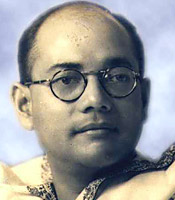 mass movement against utilizing Indian resources and men for the great war. There was a tremendous response to his call and he was put under house arrest in Calcutta. In January 1941, Subhas Chandra Bose disappeared from his home in Calcutta and reached Germany via Afghanistan. Working on the maxim that "an enemy's enemy is a friend", he sought cooperation of Germany and Japan against British Empire. In January 1942, he began his regular broadcasts from Radio Berlin, which aroused tremendous enthusiasm in India. In July 1943, he arrived in Singapore from Germany. In Singapore he took over the reins of the Indian Independence Movement in East Asia from Rash Behari Bose and organised the Azad Hind Fauj (Indian National Army) comprising mainly of Indian prisoners of war. He was hailed as Netaji by the Army as well as by the Indian civilian population in East Asia. Azad Hind Fauj proceeded towards India to liberate it from British rule. Enroute it lliberated Andeman and Nicobar Islands. The I.N.A. Head quarters was shifted to Rangoon in January 1944. Azad Hind Fauj crossed the Burma Border, and stood on Indian soil on March 18 ,1944.